
Abstract Tattoos Explained: When Art Becomes Emotion on Skin

Updated: Aug 13
In a world where tattoos often depict recognizable symbols, portraits, or imagery, abstract tattoos offer something entirely different—an opportunity to express emotions, experiences, and ideas without relying on literal representations. At Ink Lucid Tattoo Studio, we believe that tattooing is a form of personal storytelling, and abstract art allows that story to be interpreted in a deeply individual way.
Unlike traditional tattoo styles, abstract tattoos focus on shapes, textures, movement, contrast, and composition. They create a visual language that speaks to feelings rather than specific objects, making every design highly personal and open to interpretation.
What Makes a Tattoo Abstract?
Many people choose tattoos to commemorate milestones, express their identity, or capture meaningful memories. However, not every emotion can be represented by a symbol or image. This is where abstract tattoos become powerful.
Abstract tattoos don't necessarily represent an object exactly as it appears in the real world. Instead, they may use lines, shapes, textures, distortion, negative space, color, or unexpected compositions to communicate an idea or feeling.
An abstract tattoo could represent movement without depicting a moving object, emotion without using an obvious symbol, or a personal experience through a combination of visual elements.
Common characteristics include:
Geometric or organic shapes
Fluid linework
Distorted imagery
Negative space
Unexpected compositions
Layered textures
Minimal or intentionally ambiguous symbolism
Experimental use of color or black and grey
There isn't one fixed formula for abstract tattooing. That's part of its appeal.
Two people can experience the same abstract artwork completely differently, allowing the tattoo to develop a personal meaning rather than communicating only one predetermined message.
Abstract tattooing often focuses more on emotion, movement, and interpretation than literal imagery. Explore Surrealism Tattoos Explained to discover another tattoo style where imagination plays a central role.
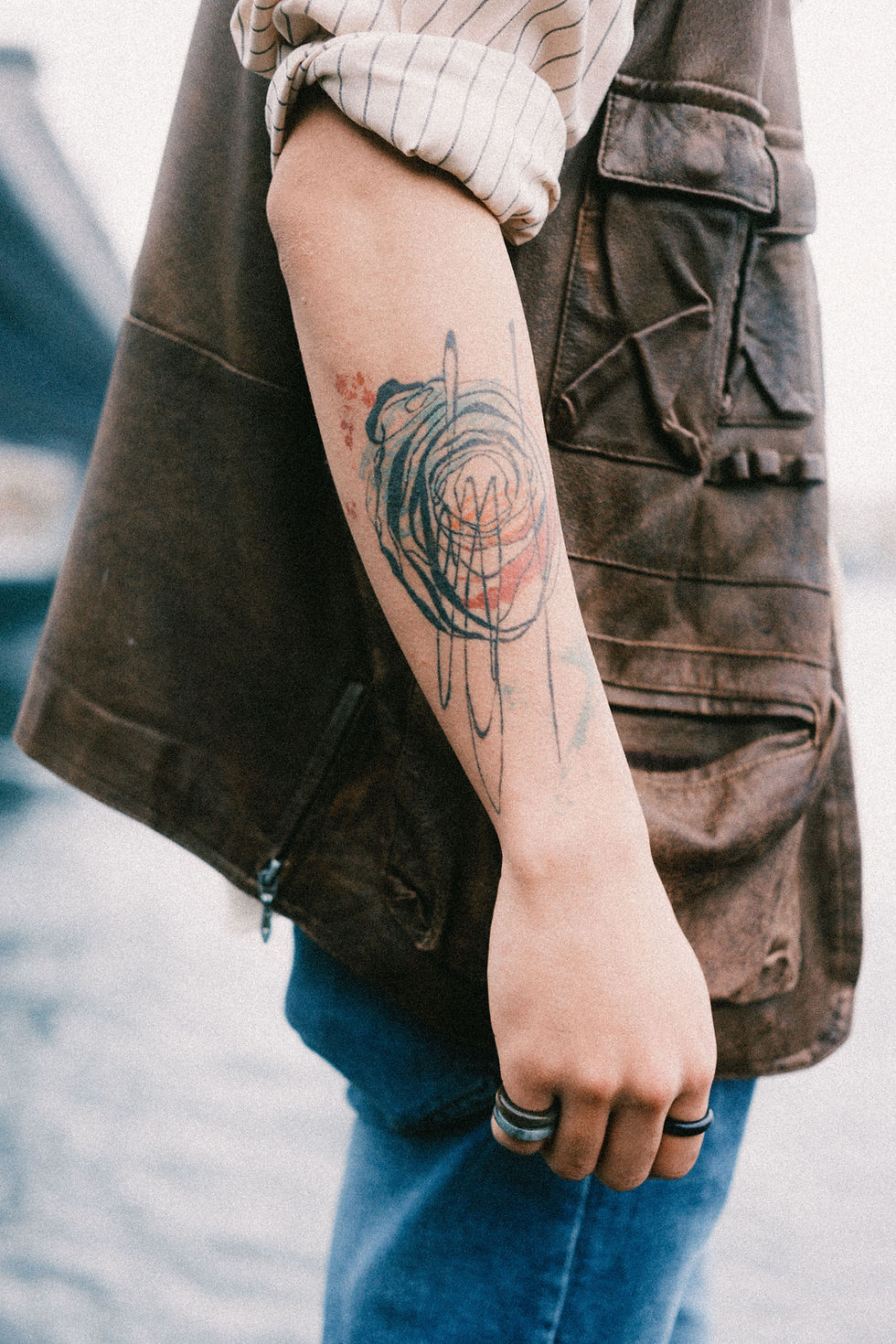
Abstract Tattoos vs Traditional Imagery
One of the greatest advantages of abstract tattooing is creative freedom. There are no strict rules governing composition, subject matter, or style. Elements from fine art, modern design, surrealism, geometry, and illustration can be blended into a single cohesive piece.
This flexibility makes abstract work ideal for individuals seeking custom tattoos that truly stand apart. Instead of selecting a design from a catalog, clients collaborate with the artist to develop something entirely unique.
The result is a tattoo that evolves from emotion and imagination rather than imitation.
Different styles to consider:
Abstract Tattooing: Focuses on shapes, lines, composition, movement and interpretation.
Surrealism: Often combines recognizable imagery in dreamlike, unexpected or impossible ways.
Geometric Tattooing: Uses structured forms, symmetry, patterns and mathematical or visual precision.
Conceptual Tattooing: Uses visual storytelling to communicate an idea, theme, or narrative.
How Do You Turn an Emotion Into an Abstract Tattoo?
One of the most interesting aspects of abstract tattooing is its ability to represent something that doesn't have a physical form.
Instead of asking, "What object should I get tattooed?", you can start with a different question:
"What do I want this tattoo to make me feel?"
A feeling such as freedom could be represented through flowing lines and open negative space. A period of personal transformation might inspire fragmented shapes evolving into a more structured composition.
The process can begin with:
A memory
An emotion
A personal experience
A relationship
A period of change
A sound, place, or movement
A philosophical idea
The artist then interprets those elements visually.
This doesn't mean giving the artist complete control over the meaning. Instead, it creates a collaborative process where your personal experience provides the foundation and artistic interpretation determines how that experience can become visual language.
Your Tattoo Doesn't Have to Look Like Everyone Else's
Abstract tattooing gives you the freedom to move beyond literal imagery and explore shapes, movement, contrast, symbolism, and emotion.
If you have an idea that is difficult to describe visually, a custom approach can help turn that feeling into artwork designed specifically for you.
Choosing the Right Placement for an Abstract Tattoo
Placement plays an especially important role in abstract tattoos because many designs rely on movement, flow, and composition rather than a fixed central image.
Curved areas such as the shoulder, upper arm, forearm, thigh, calf, ribs, and back can provide interesting surfaces for designs that follow the natural movement of the body.
The size of the tattoo also matters. A design with several overlapping elements may need sufficient space for each component to remain visually distinct.
Before choosing a placement, consider:
How the design follows your body's contours
Whether the tattoo needs to remain visible or private
How much space the composition requires
Whether you want the design to expand later
How the placement interacts with existing tattoos
For abstract work, placement isn't simply where the tattoo goes. It can become part of the artwork itself.
A tattoo doesn't always need an obvious symbol to carry personal meaning. Read The Psychology Behind Meaningful Tattoos to explore why people connect emotionally with the artwork they choose.
Why Abstract Tattoos Are Highly Personal
Abstract tattoos challenge traditional ideas of what tattoo art should be. They allow emotions, memories, and individuality to take center stage through creative visual expression. For those seeking meaningful body art that goes beyond literal imagery, abstract tattoos offer an inspiring and deeply personal solution.
At Ink Lucid Tattoo Studio, every abstract piece is designed to become more than a tattoo—it becomes a lasting reflection of who you are, expressed through art on skin.
Looking for more unconventional inspiration? Explore How Conceptual Tattoos Are Redefining Modern Ink Culture to see how tattooing can move beyond conventional imagery and become a form of visual storytelling.
FAQs
What is an abstract tattoo?
An abstract tattoo uses shapes, lines, textures, composition, distortion, negative space, or other artistic elements rather than relying solely on realistic or literal imagery.
Do abstract tattoos have meaning?
They can. Some are deeply personal and symbolic, while others are chosen primarily for their visual or emotional impact. The meaning can be completely individual to the wearer.
Are abstract tattoos difficult to design?
They can be. Because abstract designs don't always follow conventional imagery, creating balance, movement, contrast, and visual cohesion requires strong artistic judgment.
Can an abstract tattoo include realistic elements?
Yes. Abstract designs can be combined with realism, geometric elements, surrealism, nature imagery, or other tattoo styles to create mixed-style compositions.
What is the best placement for an abstract tattoo?
It depends on the design. Areas with enough space and natural contours—such as the arm, shoulder, thigh, back, ribs, or calf—can work particularly well for flowing or large-scale abstract compositions.
Turn an Idea, Feeling, or Memory Into Art
Abstract tattoos offer something that conventional imagery sometimes cannot: the freedom to interpret an idea rather than simply illustrate it.
At Ink Lucid Tattoo Studio, unconventional concepts can be developed into personalized artwork that combines composition, symbolism, and artistic expression.

Comments